
«Léon-La-Terreur»
Exposition 05/02 > 28/02/2026
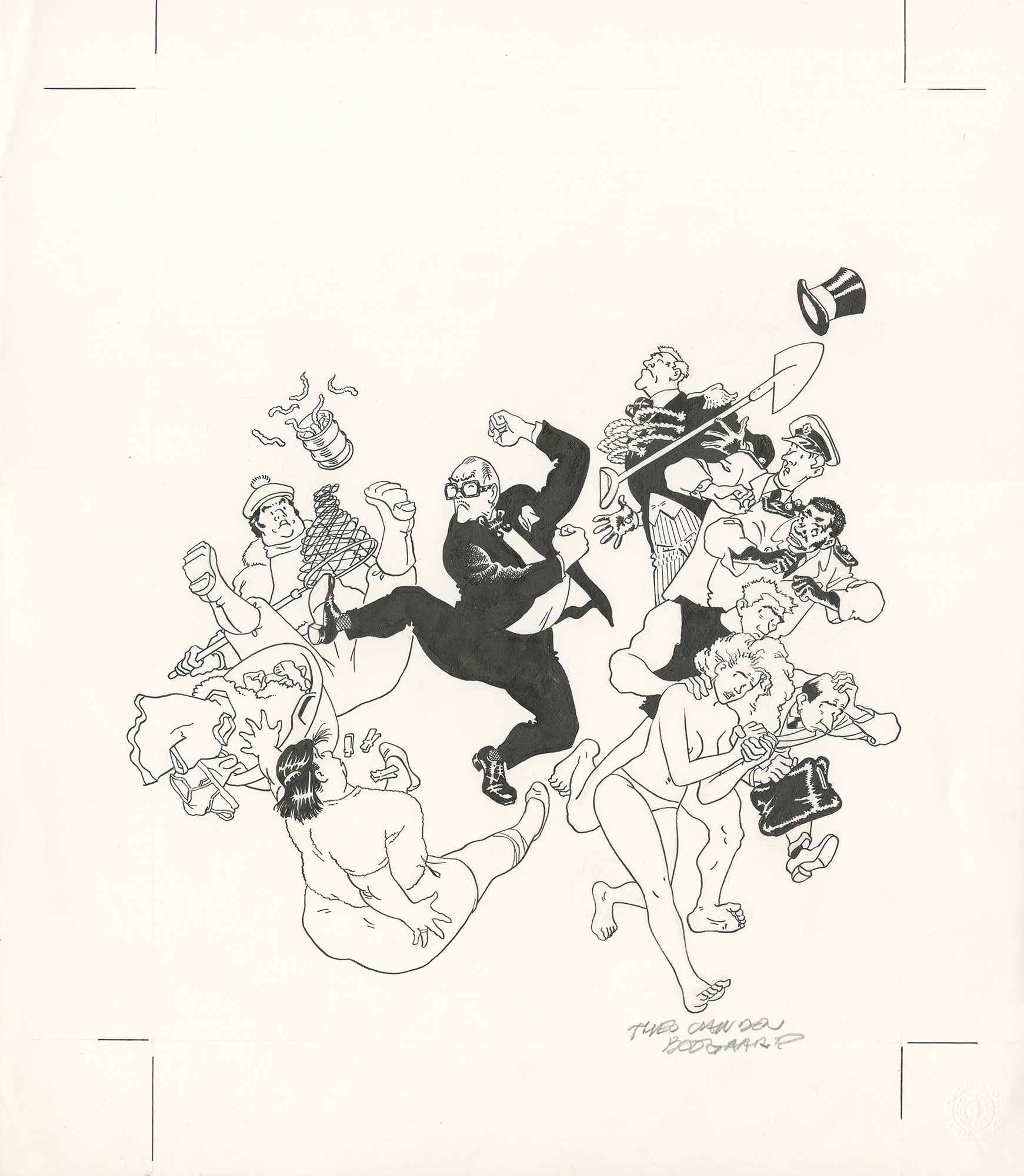
Dans chaque planche de Léon-la-Terreur, Theo van den Boogaard allie la virtuosité d’André Franquin à la rigueur d’Hergé pour créer une véritable chorégraphie personnelle. Comme son alter ego Joos Swarte, il officia d’abord dans la BD underground avant de devenir un Maestro de la Ligne claire. Chez lui, elle allie lisibilité graphique et discours irrespectueux, tout en gardant un trait hyperdynamique.
Van den Boogaard doit sa célébrité, en France comme au Benelux, à Sjef van Oekel (Léon van Oekel ou Léon-la-Terreur en français), série qu’il anima de 1976 à 1999 avec Wim T. Schippers. Le personnage apparaît pour la première fois en 1976 dans De Nieuwe Revue, un hebdomadaire progressiste des Pays-Bas. En 1980, le premier album est publié simultanément en néerlandais, allemand et français. Le succès est immédiat. La série, irrévérencieuse et décapante, véritable pavé dans la mare des idées bien pensantes, est accueillie dans L’Echo des Savanes. Revêtu d’un costume impeccable, Léon fait subir un traitement de choc à toutes les couches de la société, via une escalade de l’absurde et de la folie, en dépit d’un décor réaliste composé d’architecture, de scènes de rue, de transports en commun et d’objets habituels, tous reconnaissables. Dans cette logique du délire, l’éclatante bêtise de Léon est sans limite.
L’auteur assume les influences de ses prédécesseurs, à commencer par celle d’Hergé : Il est en place d’honneur parmi mes influences avec son grand talent de narrateur et, comme dessinateur, sa science de la composition, de la distribution des espaces, de la stylisation et de la reproduction de matière. Son influence a surtout été pour moi de l’ordre de la composition : la construction autour d’un parfait centre de gravité. Mais il se veut aussi l’héritier de Carl Barks, Hans G. Kresse, Willy Vandersteen, Franquin, mais aussi des grands dessinateurs de MAD : Jack Davis, Bill Elder ou Wallace Wood.
«Sjef Van Oekel»
Met elke plaat van Sjef Van Oekel combineert Theo van den Boogaard de virtuositeit van André Franquin aan de strakheid van Hergé om zo een ware, persoonlijke choreografie te scheppen. Net als zijn alter ego Joost Swarte was hij eerst actief in de underground strip voor hij een meester van de Klare Lijn werd. Bij hem betekent het een grafische leesbaarheid en respectloze dialogen maar toch met hyperdynamische lijnen.
Van den Boogaard heeft zijn roem in Frankrijk en de Benelux te danken aan Sjef van Oekel (Léon van Oekel of Léon-la-Terreur in het Frans), een reeks die hij van 1976 tot 1999 bracht in samenwerking met Wim T. Schippers. Het personage verschijnt voor het eerst in 1976 in De Nieuwe Revue, een progressief Nederlands weekblad. In 1980 wordt het eerste album tegelijkertijd gepubliceerd in het Nederlands, Duits en Frans. Het is meteen een succes. De reeks, respectloos en bijtend, gegrond in een vloedgolf van wel doordachte ideeën, wordt opgevangen in L’Echo des Savanes. In zijn onberispelijk pak geeft Sjef een schoktherapie aan alle lagen van de maatschappij via een stortvloed van absurditeit en gekheid en in sterk contrast met een realistisch decor van architectuur, straatscènes, openbaar vervoer en gewone voorwerpen, allen erg herkenbaar. In deze logica van waanzin is de verbluffende domheid van Sjef grenzeloos.
De auteur erkent de invloeden van zijn voorgangers, te beginnen met die van Hergé: Hij heeft een ereplaats bij mijn invloeden met zijn groot verteltalent en, als tekenaar, zijn kennis van compositie, de verdeling van de ruimten, de stilering en weergave van materie: de constructie rond een perfect zwaartekrachtcentrum. Maar hij noemt zich ook een erfgenaam van Carl Barks, Hans G. Kresse, Willy Vandersteen, Franquin, naast de grote tekenaars van MAD: Jack Davis, Bill Elder of Wallace Wood.
«Léon-La-Terreur»
On every page of Léon-la-Terreur Theo van den Boogaard combines the virtuosity of André Franquin with the rigour of Hergé to create a truly personal choreography. Like his counterpart Joost Swarte, he first worked in underground comics before becoming a master of the Clear Line style. His drawing blends graphic clarity with irreverent commentary, while always maintaining a hyper-dynamic line.
Van den Boogaard owes his fame, in France and the Benelux countries, to Sjef van Oekel (Léon van Oekel, or Léon-la-Terreur in French), a series he created from 1976 to 1999 with Wim T. Schippers. The character first appeared in 1976 in De Nieuwe Revue, a progressive weekly newspaper in the Netherlands. In 1980, the first album was published simultaneously in Dutch, German, and French. It was an immediate success. The irreverent and scathing series, a veritable bombshell on conventional thinking, was welcomed in L’Écho des Savanes. Dressed in an impeccable suit, Léon subjects all levels of society to shock therapy through escalating absurdity and madness, despite a realistic setting composed of architecture, street scenes, public transportation, and everyday objects, all recognisable. Within this logic of delirium, Léon’s dazzling stupidity knows no bounds.
The author acknowledges the influences of his predecessors, starting with Hergé: He holds a place of honour among my influences with his great talent as a storyteller and, as an artist, his mastery of composition, the distribution of space, stylisation, and the reproduction of textures. His influence has been primarily in the realm of composition for me: constructing around a perfect centre of gravity. But he also sees himself as the heir of Carl Barks, Hans G. Kresse, Willy Vandersteen, Franquin, as well as the great cartoonists of MAD: Jack Davis, Bill Elder and Wallace Wood.